The Mathematical Oracle & The Infinite Tape
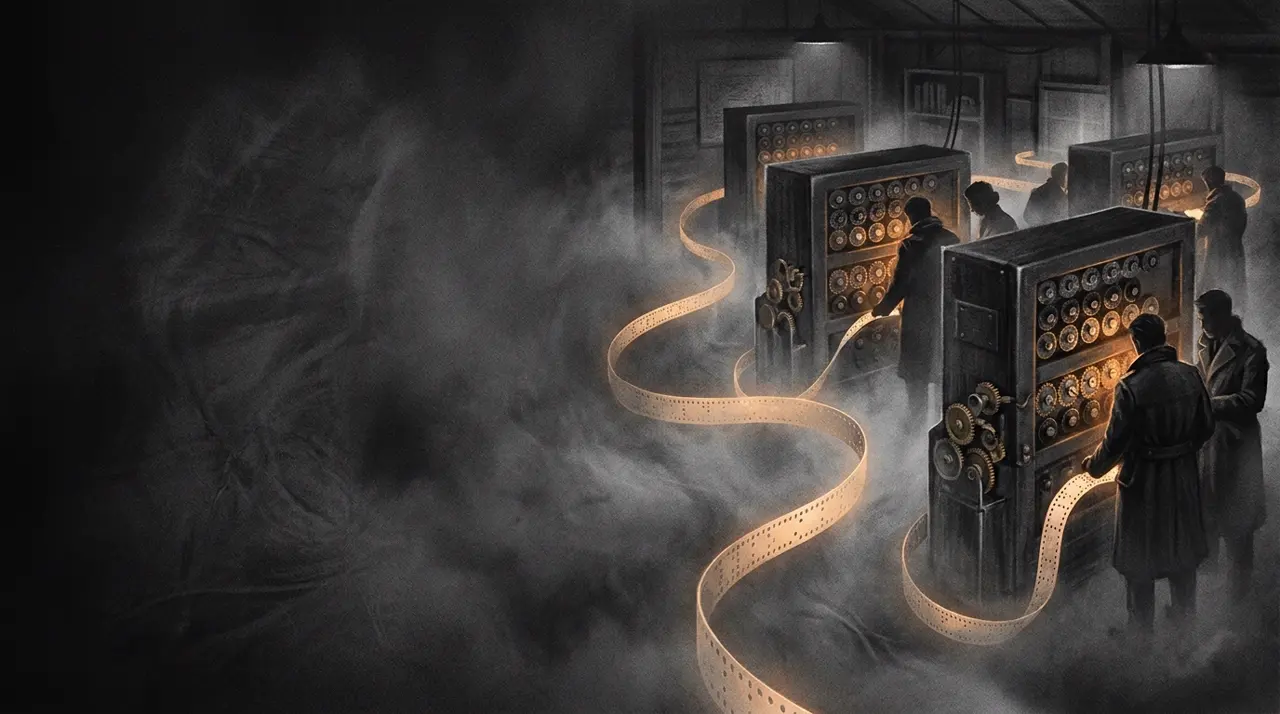
In 1936, in the revolutionary paper \"On Computable Numbers\", British mathematician Alan Mathison Turing formulated the Universal Turing Machine. He proved that a single hypothetical device, reading and writing symbols on an infinitely long paper tape, could simulate any conceivable calculating machine.
During WWII at Bletchley Park, Turing's theoretical work became operational. He designed the Bombe to break German Enigma cipher transmissions, while Tommy Flowers built Colossus (the first electronic digital computer with 1,500 vacuum tubes). In 1950, Turing published the seminal \"Computing Machinery and Intelligence\", introducing the Turing Test.
Von Neumann Architecture & The Solid-State Transistor
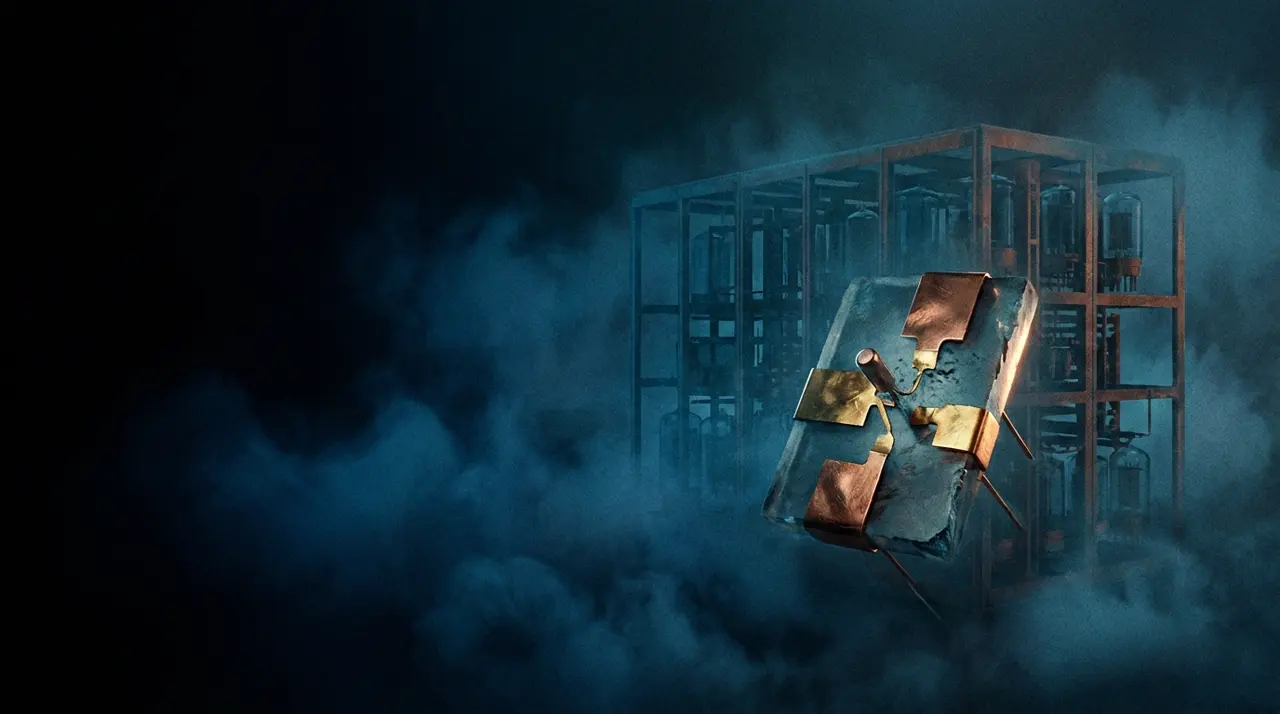
The first giant electronic computers, like the ENIAC (1946) with 18,000 vacuum tubes, filled entire rooms and failed constantly from heat. In 1945, John von Neumann published his EDVAC report, defining the Stored-Program Architecture: data and instructions share the same main memory, processed by a Control Unit and ALU. This structure governs almost all computers to this day.
On December 16, 1947, at Bell Laboratories, John Bardeen, Walter Brattain, and William Shockley invented the point-contact germanium transistor — a solid-state switch with no moving parts, cool, tiny, and infinitely faster than vacuum tubes. In 1956 at Dartmouth, John McCarthy officially coined the term \"Artificial Intelligence\".
Integrated Circuits, Moore's Law & The Intel 4004
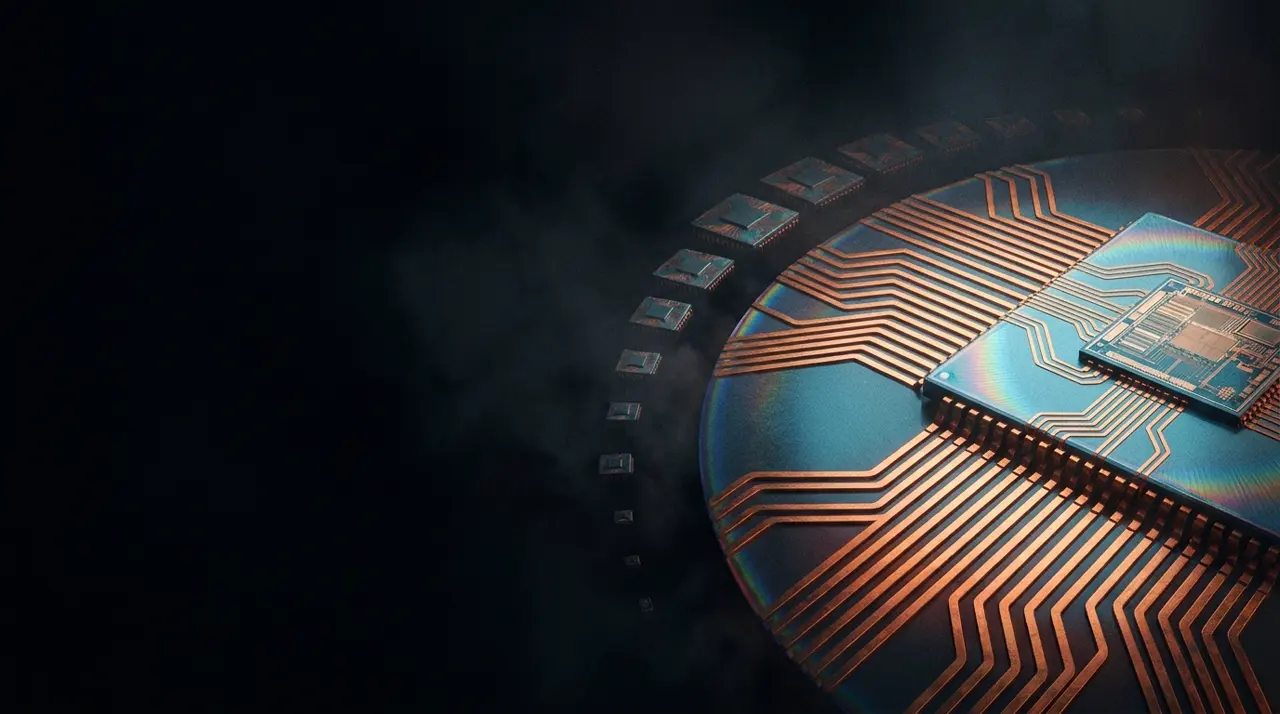
With the invention of the integrated circuit by Robert Noyce and Jack Kilby, multiple transistors could be printed on a single silicon wafer. In 1965, Gordon Moore formulated the most profitable empirical prediction in history: Moore's Law.
In 1971, Intel launched the Intel 4004: the first commercial single-chip microprocessor with 2,300 transistors. Concurrently, Bell Labs birthed UNIX and the C language (Dennis Ritchie and Ken Thompson), while ARPANET made its first transmission in 1969, weaving the foundations of the global digital infrastructure.
Personal Computers, The World Wide Web & Backprop
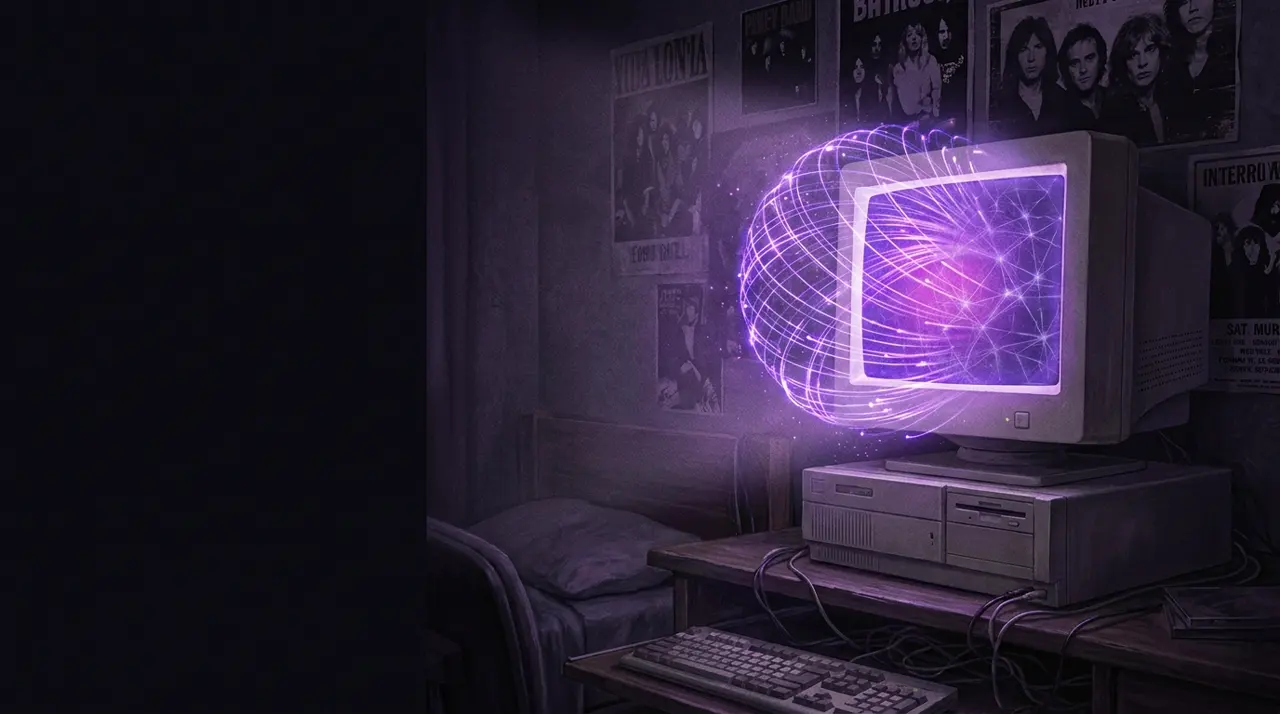
Computers finally left corporate data centers and invaded homes. The IBM PC (1981) and iconic Apple Macintosh (1984) popularized the graphical interface with windows, icons, and the mouse. In 1989, at CERN, Tim Berners-Lee invented the World Wide Web (HTTP, HTML, and URLs), connecting humanity in a single hypertext web.
In AI, after a long \"winter\", David Rumelhart, Geoffrey Hinton, and Ronald Williams published the Backpropagation algorithm in 1986, proving that multilayer neural networks could learn complex internal representations through gradient descent.
Cloud Computing, CUDA GPUs & The Deep Learning Big Bang
At the turn of the millennium, computation migrated to elastic data centers with cloud computing (AWS EC2). Concurrently, NVIDIA launched the CUDA platform in 2006, unlocking massively parallel GPU power for linear algebra and matrix operations.
In October 2012, Alex Krizhevsky, Ilya Sutskever, and Geoffrey Hinton won ImageNet with AlexNet, crushing classical computer vision methods and launching the modern Deep Learning boom. In March 2016, AlphaGo shocked the world by defeating Lee Sedol at Go.
The Transformer Revolution & The Generative AI Boom
In June 2017, eight Google researchers published the historic paper \"Attention Is All You Need\". The Transformer architecture replaced recurrent networks with the Self-Attention mechanism, enabling supercomputers to train in parallel on billions of web pages without sequential bottlenecks.
The leap with GPT-3 (2020) and the global launch of ChatGPT (November 2022) turned AI into the fastest-adopted technology product in human history. Focus rapidly expanded to native multimodality (vision, audio, and code unified) with GPT-4o and Gemini 1.5.
The Dual Frontier: Quantum Leap (Google Willow) & System-2 Reasoning (OpenAI)
In 2026, computing history reaches its most spectacular simultaneous convergence between hardware physics and cognitive intelligence:
The Willow Quantum Chip (Dec 2024–2026)
With 105 superconducting transmon qubits, Willow became the first chip in history to cross the quantum error-correction threshold (\"below-threshold\"). As the surface-code lattice grows, the logical error rate falls exponentially.
The System-2 Reasoning Revolution (o1, o3, GPT-6 Astra)
The end of the impulsive next-token guess. The 2026 frontier is governed by test-time compute scaling: dynamically allocating thinking time so the model explores hypothesis trees and corrects itself before answering.
The Convergence of Two Epochal Trajectories
In 1936, Turing formalized computation. In 2026, Google Willow conquers quantum error correction below threshold while OpenAI unlocks step-by-step verified reasoning. The mission of Make AI Better is to ensure this immeasurable power remains transparent, safe, and accessible to all humanity.